
UCT EEE2044S / 2021
Measuring a physical system
A DC-machine lab investigating speed, armature voltage/current and torque relationships.
UCT / COURSE CONTEXT / 2021
EEE2044S · Introduction to Power Engineering
Magnetic circuits, electrical machines and single-phase transformers.
ENGINEERING PERSPECTIVE
Inside the work
Characterise a physical machine by varying its input and load. The work develops the link between an electrical model, a controlled test condition and a recorded mechanical response.
- DC motor / servo / torque sensor
- The lab setup couples the machine to a controlled load and measurement path.
- Recorded tables / plots
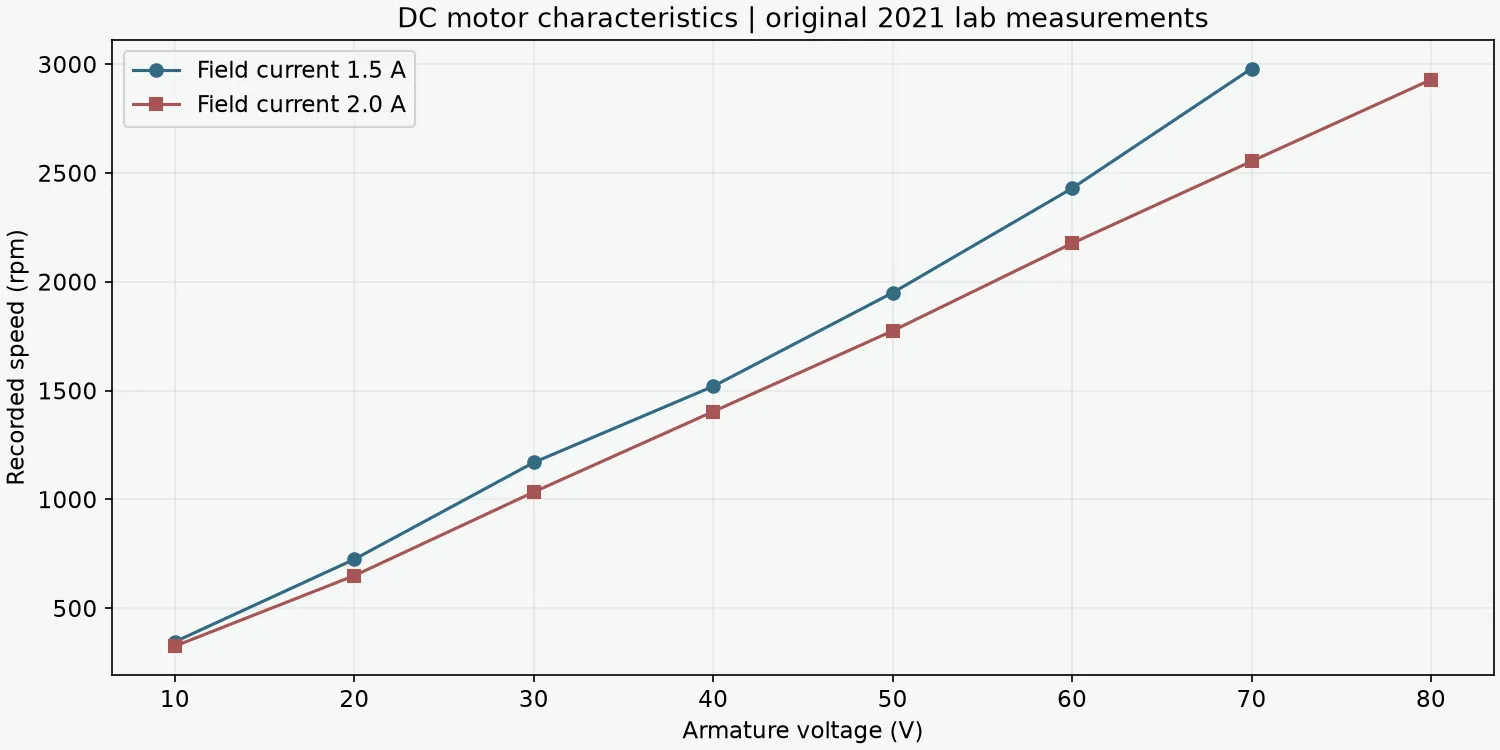
- Voltage-speed values at two field currents are replotted without inventing new measurements.
Set conditions
Choose the excitation configuration and input/load condition.
- Test conditions
- Field current, armature voltage and load define the operating point.
- Electromechanical response
- Speed, current and torque observations describe different aspects of the same system.
- Uncertainty
- Calibration and repeated trials would be needed before treating a trend as a precise model.
What the demonstration establishes
The plot derives from historical voltage-speed measurements. No new hardware retest, fitted regression or instrument-calibration result is claimed.
Evidence behind this page
Azhar-named report and recorded experimental tables.
How it works
A DC motor couples to a servo through a torque sensor. The lab changes armature voltage and load, records speed/current, and compares separately excited and series-connected configurations.
Results & recovery
- The visual regenerates only the original voltage-speed tables, including 346-2980 rpm at 1.5 A field current and 326-2929 rpm at 2.0 A.
- The report includes additional torque/current and speed-regulation tables.
Technical limitations
No hardware retest occurred in 2026. Measurement uncertainty, calibration and regressions are not reconstructed beyond the evidence supplied.
What I would improve now
Record instrument uncertainty, add repeated trials and preserve raw measurements with explicit units and test conditions.