
UCT EEE2044S / 2021
From windings to a working transformer
A collaborative transformer design, construction and load-test project, with retained build photographs and measurements.
UCT / COURSE CONTEXT / 2021
EEE2044S · Introduction to Power Engineering
Magnetic circuits, electrical machines and single-phase transformers.
ENGINEERING PERSPECTIVE
Inside the work
Connect electrical design assumptions to construction and load-test evidence. The gap between the nominal target and measured output makes regulation, losses and practical constraints part of the story.
- Windings / laminated core
- Collaborative construction used a 150:60 turns ratio and 51 core laminations.
- Load-test measurements
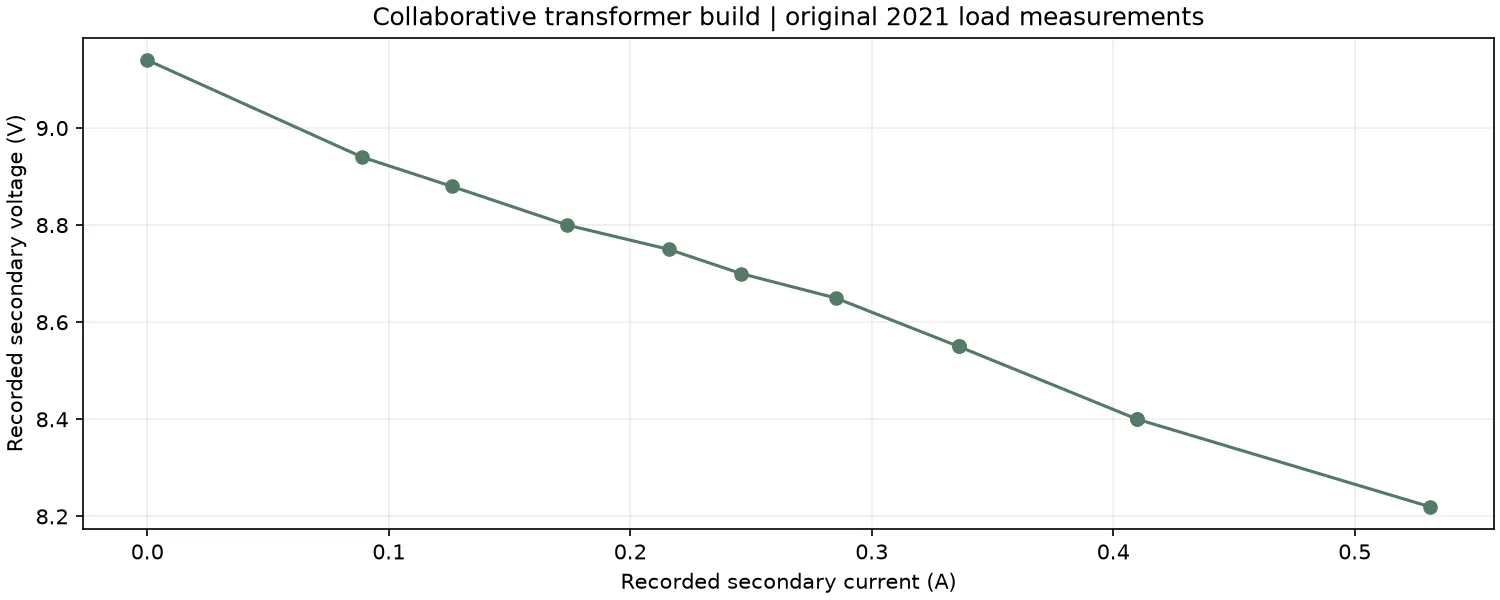
- The original report records voltage, current and input/output power; a new chart replots those values.
Design
Target 25 V to 10 V, 4.5 VA at 50 Hz using the specified winding/core choices.
- Turns ratio
- The ideal voltage ratio is a design starting point, not a guarantee under real load.
- Regulation and losses
- The recorded secondary voltage falls under load and efficiency is below the ideal model.
- Measurement provenance
- Historical tables support the reported result; they do not constitute a fresh test.
What the demonstration establishes
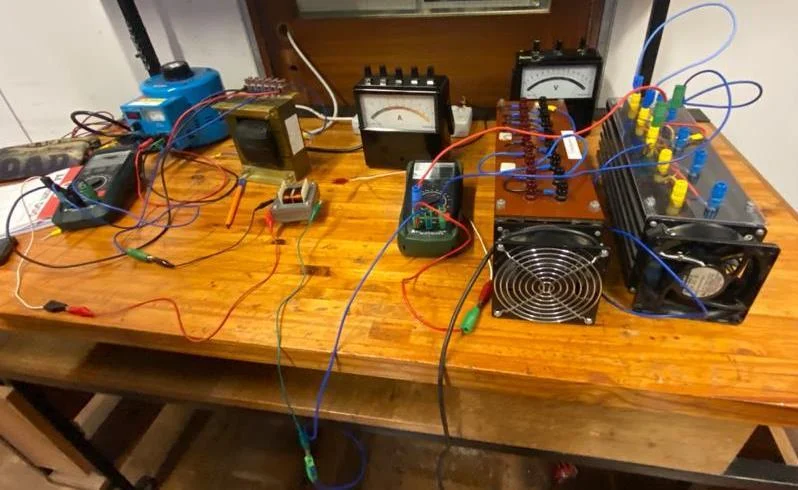
The original build photograph and replot show real collaborative lab work. Individual construction tasks and new hardware performance are not attributed.
Evidence behind this page
Group 7 report naming both participants, apparatus photograph and original measurement tables.
How it works
The team constructed a 150:60-turn transformer using 51 core laminations with a 2.51 cm assembled depth. The brief targeted 25 V to 10 V, 4.5 VA at 50 Hz. Open-circuit and load tests recorded voltage, current and input/output power.
Results & recovery
- At a 25 V primary input, the report records 9.14 V secondary at no load and 8.4 V at the labelled full-load condition.
- Recorded input and output powers of 5.67 W and 3.44 W give the report's 60.67% efficiency; these are historical lab measurements, not a fresh hardware test.
Technical limitations
The measured output did not meet the nominal 10 V design target. The published photograph and plot are from the submitted work; no claim of sole construction, new measurements or commercial-grade performance is made.
What I would improve now
Quantify winding resistance, leakage, core losses and measurement uncertainty; compare predicted and measured regulation across repeatable load sweeps.